
The Conundrum of Cover Letters
Job descriptions tend to be fairly emotionless and frequently on the hyper-professional end of the spectrum. However, applying for said job is invariably full of emotion for the applicant. Personally, these emotions range from stress and frustration to hope and excitement. Cover letters, letters of interest, personal statements, whatever you want to call them are integral to the formal and structured process of job applications. Despite this, they are incredibly subjective from both the points of view of the writer and reader.
I used to think that they were difficult because of the juxtaposition of emotion vs emotionless. Or that a lot of the time I feel the more I suit a job and a job suits me, the worse my cover letters get because I put mountains of pressure on myself. I also struggle with the fact that unlike university coursework, or even this blog, there’s very little feedback. Hand a paper in, get a grade and at least a couple of sentences about what was wrong: it might be disheartening, but at least you can change it next time. Write a cover letter and you might not even get an acknowledgement that it’s been received, let alone some suggestions for improvement.
However, having reached out to numerous people through the PSCI-COM Jisc mail email and my social media channels I have since discovered that they may be difficult because everyone hiring wants something a little different, and no one knows what that is!
Below is a list of all the recommendations I received. You might notice that some are in direct conflict with one another.
As a side note, one of the most popular pieces of advice I received was to use examples to show how you meet the job requirements, and explain why you want the job/why you’re a good fit. To me that is the definition of a cover letter so I am hoping you know those ones already.
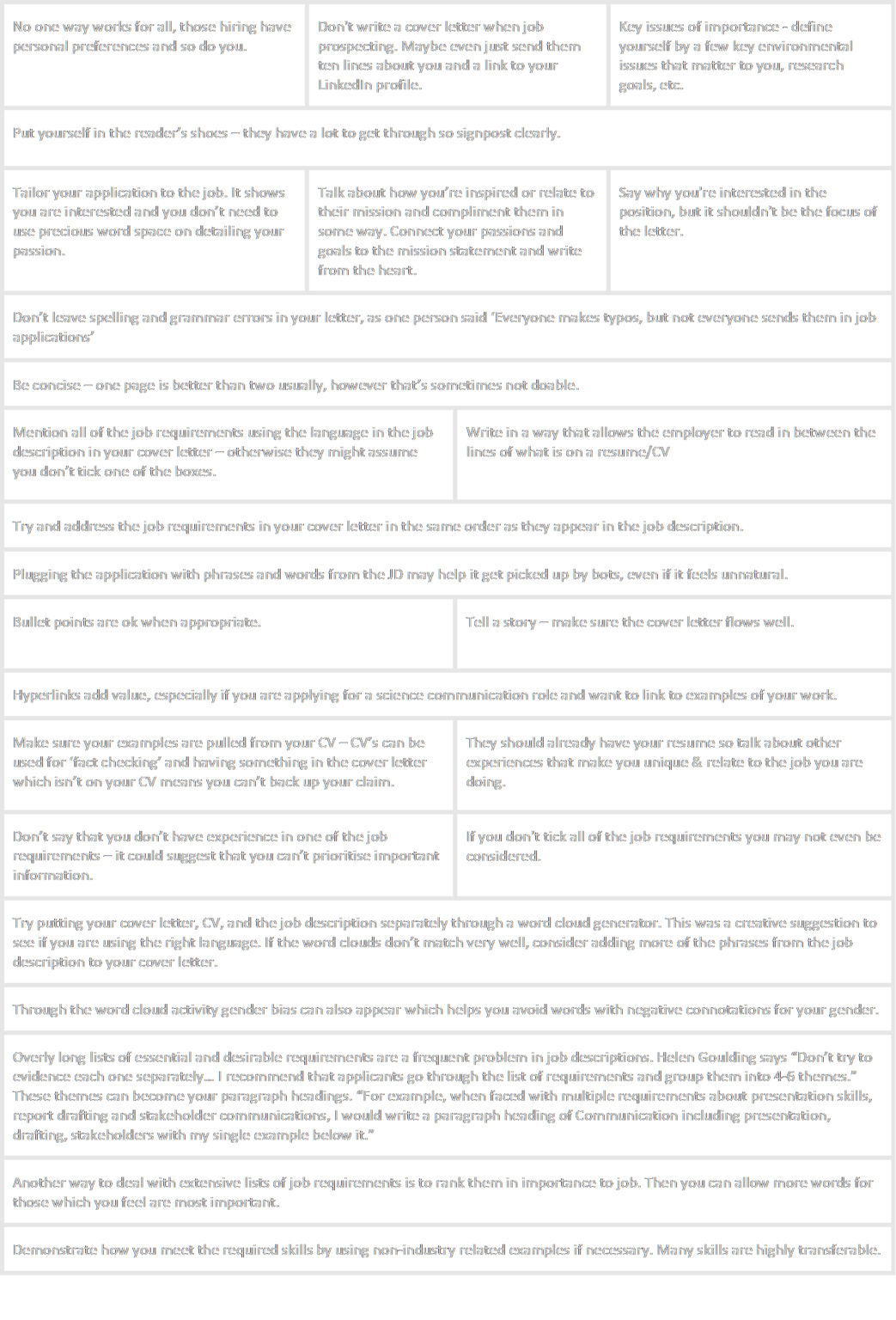
Coming to the realisation that there’s no perfect way of writing a cover letter has helped me destress the process. It reminds me that if my application is not successful, it may have nothing to do with my qualifications, experience, or motivation. I might still be worthy of the job, even though I didn’t write the cover letter they were looking for.
If you’re looking for some more advice to add to the contradictory confusion, here are a few blog posts I have come across which offer up their own take on things.
Communications roles:
Cover Letters for Communications Jobs
Science Communication: A Foot in the Door
General:
Writing a Winning Cover Letter
5 Must-Do Steps for the Winning Cover Letter
More on Bias:
Kill the Cover Letter and Resume
To Reduce Gender Bias, Anonymize Job Applications
PhDs: